
Here’s something most lenders don’t think about until it’s too late. A guy looking for a home loan won’t just walk into your branch and ask for a rate. He’ll Google your company name first, sometimes the night before, sometimes from his phone outside your office, just to double-check.
That’s the reality of housing finance now. A home loan is one of the biggest financial decisions a person makes, so people don’t take it lightly. They want proof someone else didn’t get burned before they hand over their documents and their trust.
That proof comes from reviews. And how you handle them, or don’t, can quietly decide whether your business grows or stalls.
Why does this matter so much, specifically in housing finance?
Most industries deal with reviews. But money decisions hit differently than, say, picking a restaurant. If a restaurant review is wrong, you waste one evening. If a mortgage lender review is wrong, you might be stuck with a bad EMI, hidden charges, or a process that drags on for months while your dream home slips away. So people read more carefully here. They cross-check.
Industry data backs this up. Somewhere between 93% and 97% of consumers read online reviews before making a purchase decision, and that number hasn’t moved much in years; it’s just stayed stubbornly high. For something as big as a home loan, this checking habit gets stronger, not weaker. BrightLocal’s research found people now check around six different review sites before settling on a business, not just one or two like a few years back.
So basically, your Google reviews, your listings on lending portals, even random comments on forums, are doing the job a salesperson would do. Except this one never sleeps and never takes a lunch break.
What are borrowers actually looking for when they read reviews?
Not just stars. People skim for specific things. A study going through more than 480 one-star mortgage lender reviews found patterns that repeat again and again.
Poor customer support topped the list, showing up in 56% of one-star reviews. Calls that don’t get returned, emails that vanish, automated replies instead of an actual human. After that came a lack of transparency, mentioned in 41% of complaints, things like hidden fees or promises that quietly got walked back later.
Slower process times, lender errors like wrong names on paperwork or escrow mix-ups, and undisclosed fees all show up often, too.
Here’s the thing, though. Almost none of these complaints are about the interest rate itself. People rarely write an angry review because the rate was a bit high. They write angry reviews because nobody explained things clearly, or the loan officer went quiet halfway through. Fix communication and transparency, and you’ve already removed most of your bad review risk.
So how much do reviews really move the needle?
A lot more than most finance companies assume. Here’s a quick look at where things stand right now, going into 2026.
| What does the data show? | Number |
| Consumers who say reviews shape their buying decisions | 93% |
| Consumers aged 18-34 who trust reviews as much as personal advice | 91% |
| Shoppers who avoid a business with fewer than 20 reviews | 47% |
| Consumers who’ll only trust a business rated 4.5 stars or higher | 31% |
| Sales lift when a business shows 5 or more reviews | up to 270% |
| Consumers who check Google reviews first, before anywhere else | 81% |
| Businesses that actually bother to respond to their reviews | roughly 5% |
| Consumers who expect a response when they leave a review | 89% |
Look at that last line again next to the one above it. Eighty-nine percent expect a reply. Five percent of businesses give one. That gap is an opportunity hiding in plain sight. In a field as trust-sensitive as home loans, simply being the lender who replies to every review, good and bad, puts you ahead of almost everybody else without spending a single rupee on ads.
There’s a deeper trust problem in finance generally, too. Edelman’s Trust Barometer puts financial services near the bottom of trusted industries worldwide, with roughly 55-59% saying they trust the sector to do right by them, against 70-75% for tech or food brands. Borrowers come in a little guarded already. Your reviews either calm that guard down or confirm their fear.
What actually happens if you just ignore your reviews?
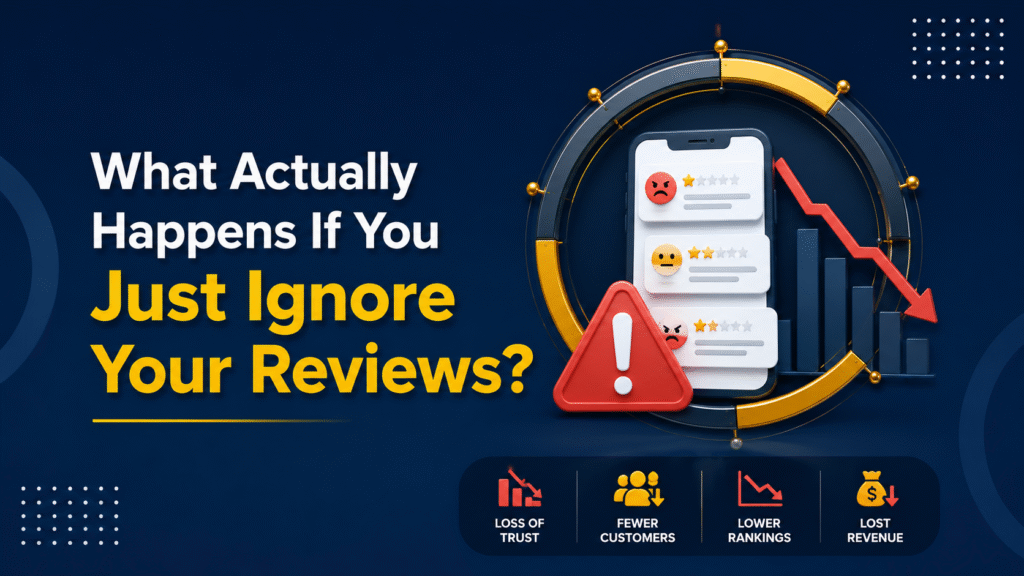
A few things, and none of them work in your favor.
Your search ranking slips first, quietly. Review signals feed directly into how Google ranks local businesses, alongside how complete your business profile is. A lender sitting on old, thin, or mostly negative reviews simply shows up lower than a competitor with fresh, detailed ones. You won’t notice it happening; you’ll just notice fewer calls coming in.
Then you lose deals before anyone on your team picks up the phone. Someone comparing three lenders will quietly cross one off the list before reaching out, purely because a 3.2-star rating sat next to a competitor’s 4.6. No complaint call, no drama. Just gone.
And one unanswered bad review can color opinion for months. There’s some good news, though. Recent data shows 74% of consumers only really care about reviews from the last three months, so older complaints do fade. But if the same complaint keeps repeating, slow replies, surprise fees, whatever it is, new visitors start noticing the pattern instead of the one bad post. That’s harder to shake off.
How do you actually get more reviews from borrowers?
Most lenders get this backwards. They wait for reviews to show up on their own, then panic when only the angry borrowers bother writing one. Happy borrowers rarely leave a review unless someone asks them, directly, at the right moment.
The right moment is right after closing, not weeks later. The day the loan disburses, or right after the keys get handed over, is when relief is highest and gratitude is freshest. Send a short message then, not a generic one blasted to your whole database every quarter.
Make it easy too. A direct link to your Google review page, sent over WhatsApp or email, works far better than asking someone to “search us on Google and leave feedback.” Every extra step you add is a borrower who gives up halfway.
Timing the ask matters more than most lenders realize. One often cited stat puts it simply, asking right after a good experience can lift response rates by 80% compared to asking days or weeks later. Whether the lift is exactly that number in your case or not, the direction is always the same. Strike while it’s fresh.
It also helps to make this a normal part of your process, not a special favor you ask for occasionally. If every loan officer sends the same review request at the same step in the closing process, every time, you stop relying on memory and start building a habit. Over months, that habit is what turns into a steady, believable stream of fresh reviews instead of a handful of old ones sitting untouched for a year.
How does Build Brand Better help housing finance brands fix this?
This is the exact gap we work in at Build Brand Better. We’re an online reputation management company based in Delhi, working with banks, NBFCs, brokers, and financial brands across India and increasingly abroad too. Our review management services are built for the pressure points finance brands deal with: high stakes, public scrutiny, and a borrower base that checks everything twice before committing.
In practice, that work looks like this. We monitor reviews across Google, Glassdoor, Trustpilot, and lending portals, since borrowers check around six platforms on average, not just one. We respond to every review on your behalf, good or bad, with a clear and consistent process, closing that 84-point gap between what borrowers expect and what most lenders actually deliver. When fake or policy-violating reviews show up, and in finance, they sometimes do, from competitors even, we flag them and push for removal. We also work on pushing down old negative press or outdated complaint threads that no longer reflect how your business runs today, and help build a steady flow of genuine new reviews from borrowers who closed happily.
Beyond reviews specifically, we also run online reputation audits for finance brands wanting the full picture before committing to a strategy, and step in for crisis management when a single bad story starts spreading faster than your team can respond. For loan officers and executives building their own name in the industry, not just the company’s, we also offer personal branding services. In housing finance, especially, people often trust the loan officer’s name as much as the company behind them.
We’ve worked with over 1,200 clients across sectors, including real estate and finance, and most start seeing movement in rankings and sentiment within 1 to 3 months, with the fuller picture building out over 3 to 12 months.
What can you actually do starting today?
You don’t need a big budget or a six-month plan to start. Here’s where to begin, in order of how fast it pays off.
First, search your own company name on Google right now. Look at it the way a nervous borrower would. If what’s there is outdated, thin, or has unanswered complaints sitting at the top, that’s your starting point.
Second, reply to every review from the last 90 days, even the old ones you meant to get to. A late reply still helps more than silence.
Third, ask borrowers for a review within a week of closing their loan, while the relief is still fresh. Wait a month, and that motivation has usually faded.
Fourth, figure out which single complaint keeps repeating: slow replies, confusing paperwork, surprise costs, and fix that one thing internally before chasing more five-star reviews.
And fifth, if your reviews are scattered across more platforms than you can track by hand, or something’s already starting to spread, get a professional audit rather than guessing. A free consultation with our team can save you weeks of trial and error.
Reviews aren’t going away. If anything, scrutiny on housing finance brands keeps going up as more borrowers shop around online before walking into a branch. The lenders who treat reviews as a real part of running the business, not an afterthought, end up converting more of the people who were already halfway convinced to trust them.
If you want help getting started, reach out to Build Brand Better or call +91 99716 87251 for a free consultation on where your housing finance brand stands right now.
FAQs
Q.1 Does online reputation management actually help a housing finance business grow, or is it just damage control?
Answer:
Both. Online Reputation Management (ORM) not only helps remove or suppress negative content but also strengthens your brand’s credibility. A positive online reputation builds trust before potential borrowers contact your team, leading to more inquiries, higher conversion rates, and fewer customers dropping out during the loan process.
Q.2 Can negative or fake reviews about my lending company actually be removed?
Answer:
Yes, in many cases. If a review is fake, defamatory, or violates the review platform’s guidelines, it can often be reported and removed with the proper evidence and a well-documented request. Genuine reviews from real customers are generally not removable, so the best approach is to address the concerns professionally and improve the customer experience.
Q.3 How fast will I see results after starting ORM for my finance brand?
Answer:
ORM is a long-term strategy, but many businesses notice positive changes within 1 to 3 months, including improved sentiment and better search visibility. More significant business results, such as increased trust and lead generation, typically appear within 3 to 6 months. A complete reputation recovery may take 6 to 12 months, depending on the existing online reputation.
Q.4 What platforms matter most for housing finance reviews?
Answer:
Google is the most important platform because it is usually the first place borrowers check before choosing a lender. However, platforms like Glassdoor, Trustpilot, and industry-specific review websites also influence customer decisions. Managing your reputation across multiple platforms helps build stronger credibility and trust.
Q.5 Why do borrowers leave bad reviews even when the loan terms were fair?
Answer:
Negative reviews are often caused by poor communication rather than loan terms. Delayed responses, unclear explanations of fees, lack of updates during the approval process, and unmet expectations can frustrate borrowers. Transparent communication and excellent customer service are key to reducing negative reviews and improving customer satisfaction.