

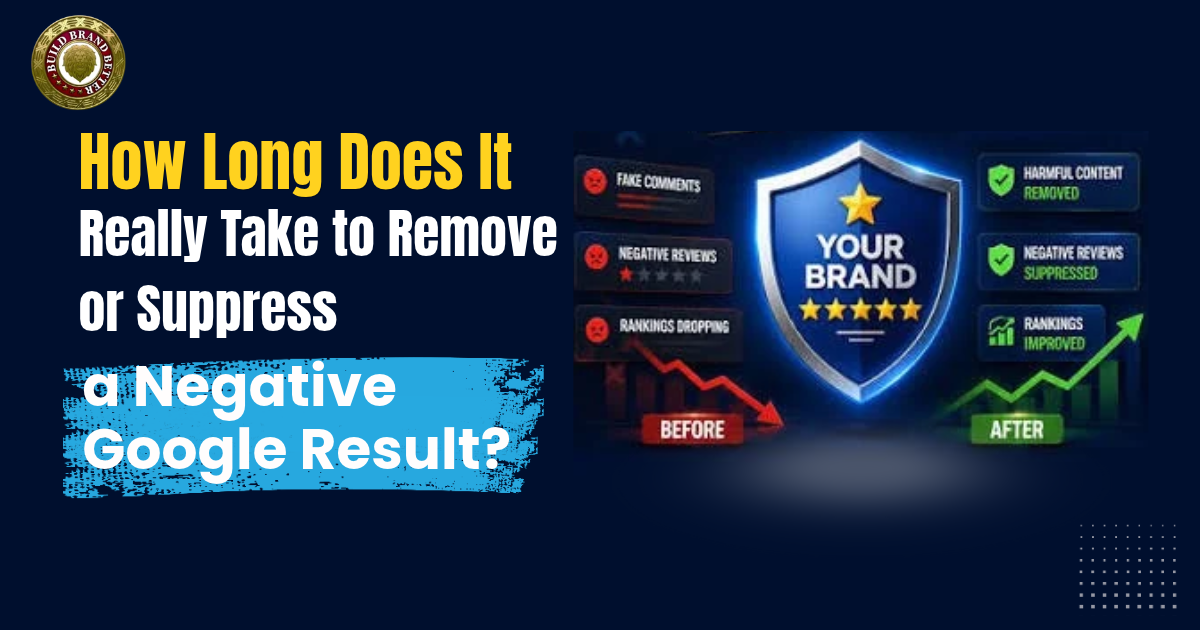
People who come to us with a bad Google result almost always ask for a number first. Days, weeks, months? There isn’t one answer, and we’d rather say that upfront than guess. The period required for removing negative search results will depend on the nature of the result, its owner and whether the action will be aimed at eliminating the page or lowering it down. Below, we will consider the two options together with realistic time frames that you should expect when trying them out.
Removal and suppression run on different clocks.
Removal implies that the page will disappear, either by disappearing off the website or from the results shown by Google. Suppression involves leaving the page online but ranking other pages (such as your own site, profiles, interviews, etc.) above it.
Online reputation repair time depends mostly on which of the two applies to your case, and most real cases need both. A removal can wrap up in a couple of weeks. Suppression can’t, because new pages need time to get indexed and earn trust.
How long does Google take to de-index a URL?
Google doesn’t publish a fixed time. It depends on how the page is leaving. This is what we usually see:
- Page deleted or marked noindex by the site owner: Google has to visit the page again and notice the change. On a busy website, that can take a few days. On a quiet page, it can run to several weeks.
- The page is already gone but still showing in results: Google’s outdated content tool is made for this. Most of the requests take several days, depending on how clearly they were stated.
- Search Console removals tool (website owners only): it works within about a day, yet it will hide the URL for no more than six months. The page should be edited anyway.
So how long does Google take to de-index a URL after the source page has been eliminated? It will take several days up to several weeks.
The slow part is rarely Google. It’s getting the website owner to act. A forum admin may not reply for weeks, and a news publisher may simply say no. One more thing people miss: the outdated content tool only works if the content is really gone or changed on the page. If it still shows there, the request gets denied.
When the page can’t be deleted:
Some pages stay online no matter how politely you ask. There are still several options to choose from.
- Personal details: Google has a form and a tool for things like phone numbers and home addresses. Requests get reviewed and can be approved or rejected. It removes the result from search, not the page from the website.
- Rule-breaking content: fake reviews or harassment can be flagged to the platform with evidence. Timings differ by platform, so we wouldn’t put one number on it.
- Court orders: some Indian courts have become more open to right-to-be-forgotten requests. In May 2026, the Delhi High Court said the right is part of the right to privacy, mainly in cases involving court records and people who were acquitted. Once an order exists, search engines are often given a short window to comply, sometimes just days or a couple of weeks. Getting the order is what takes time, and not every case qualifies, so speak to a lawyer before planning around it.
How long does it take to push down negative Google results?
Suppression is slower because the new content has to be built, indexed and trusted before it can outrank a page that’s already sitting there. From what we see, and what’s commonly reported in the industry, the ranges look like this:
- A few bad reviews or a small complaint: about 2 to 4 months
- A low-authority blog or forum page: about 3 to 6 months
- An old article on a big news site: 6 to 12 months, sometimes more
At Build Brand Better, we tell clients roughly the same thing: first movement in 1 to 3 months, bigger changes between 3 and 6 months, and a full rebuild between 6 and 12. So if you’re wondering how long it takes to push down negative Google results, plan for at least three months before page one looks clearly different.
Is it worth the wait? One study of around 4 million Google results found that only 0.63% of searchers click anything on the second page. A result that slides to page two or three loses most of its reach, even though it still exists.
What changes the negative search result suppression timeline?
- How strong the website hosting the negative page is. A big news site is much harder to outrank than a small blog.
- How old the page is and how many other sites copy or link to it.
- How many other pages already compete for your name or brand?
- What you already have. An active website, a complete LinkedIn page and a Google Business Profile give us a head start. Starting from nothing takes longer.
- How steady the work is. Regular content over several months works better than one big burst.
A realistic reputation repair timeline:
This is the plan we’d normally follow. The months are approximate, and we change them for each case.
- Weeks 1 to 2: audit. At Build Brand Better, we start by checking every result that shows up for your name or brand: which ones rank, who owns them, and which can be removed versus only pushed down.
- Weeks 2 to 6: removal attempts. We contact site owners, file Google requests and flag policy violations.
- Months 1 to 3: build. We strengthen your own website and profiles and publish content that can rank for your name.
- Months 3 to 6: movement. The negative result usually starts slipping down from page one. We check rankings every month and change the plan if something isn’t working.
- Months 6 to 12: keep it steady. Rankings can shift after Google updates, so some monitoring carries on.
This reputation repair timeline is only a guide. A simple removal might finish at step 2. A case with a big news article could use every step. Online reputation repair time also gets longer when the same story is copied across many websites.
Be careful with anyone promising a date.
Nobody controls Google. If a company promises page one in two weeks or a fixed removal date, ask how they plan to do it. Shortcuts like fake reviews, bulk low-quality pages or paid link schemes can work for a short while and then bring the negative result back up. Honest ranges sound less exciting, but they’re the ones you can actually plan around.
Not sure which route your result needs?
We can look at the result, check whether it can be removed or only suppressed, and give you a straight range for your case. Our team at Build Brand Better works on content removal, suppression, review management and Google autocomplete issues for individuals and businesses. A free consultation is a good place to start.
The honest summary:
Removal usually takes a few days to a few weeks once the source page is gone, though getting the site owner to act can add time. Legal routes depend on the court. Suppression takes months, and the negative search result suppression timeline gets longer if the page sits on a strong news site. Most cases mix a few routes, so first work out which results can go and which will stay and need pushing down. How long to remove negative search results is hard to say before that check, but a realistic reputation repair timeline from day one makes the whole thing much less stressful.
FAQs
Q1. How long does Google take to de-index a URL?
Once the page is deleted or marked noindex, it usually takes a few days to a few weeks, depending on how often Google visits that page. Requests through the outdated content tool are often handled in a few days.
Q2. How long does it take to push down negative Google results?
Usually 3 to 6 months for a clear change, and 6 to 12 months or longer if the result is on a large news site. Smaller issues like a few bad reviews can move in 2 to 4 months.
Q3. How long to remove negative search results if the website owner agrees?
If the owner deletes the page, it normally drops out of Google within a few days to a few weeks. Using Google’s outdated content tool can shorten the wait.
Q4. What is a normal online reputation repair time for a small business?
For most small business cases, clear changes take around 3 to 6 months, with early movement in the first 1 to 3 months. It takes longer if the page sits on a strong news site or many sites copy it.
Q5. Can Google remove a news article about me?
Google doesn’t usually remove a news article just because it’s negative. Removal normally needs the publisher to take it down or a legal basis like a court order. Otherwise, suppression is the usual route.
Q6. Will a negative result come back after it’s pushed down?
It can. Rankings move after Google updates, and the original page is still online. Keep publishing and check your results every month or so.
Q7. Does the reputation repair timeline differ for individuals and businesses?
Not by much. The strength of the negative page and the competition for your name matter more than who is affected. A business with an active website and review profiles often has more to work with from day one.
Q8. Can the negative search result suppression timeline be shortened?
A little. Improving pages that already rank for your name, like your website or LinkedIn profile, is faster than starting new ones. Anything that promises a few weeks should be questioned.
